
It is the first mechanical question on almost every villa and boutique hotel we price: individual split units, or a VRV (variable refrigerant volume) system? Both keep rooms cool. They differ in what they cost to buy, what they cost to run, how they fail, and what they ask of the installer.


Split units: simple, independent, visible

  • Lowest first cost and the simplest installation — one indoor unit, one outdoor unit, one short refrigerant circuit.
  • Failures stay local. If one unit stops, one room is warm. Spare units are easy to stock.
  • The cost is on the facade and the roof. Twenty rooms means twenty outdoor units that need space, airflow, drainage and screening — and twenty compressors each cycling on its own.


VRV: one system, many rooms

  • Several indoor units share one outdoor system. Inverter compressors adjust output continuously, so part-load efficiency — which is how a hotel runs most of the day — is usually much better.
  • Central control lets the front office set back unsold rooms and lets engineering see faults before guests report them.
  • It is less forgiving to install. Long refrigerant pipe runs, branch joints and a larger refrigerant charge mean brazing quality, nitrogen purging, pressure testing and evacuation have to be done properly every time.
  • Check the smallest room. With a larger shared charge, designers must confirm that a leak into the smallest occupied room would stay within the refrigerant concentration limits of the applicable safety standard.

A split unit forgives a rushed installer. A VRV system remembers every bad braze for the rest of its life.

BCM Project Team

How we usually advise

  • A private villa of three to five bedrooms with irregular occupancy: well-chosen inverter split units are often the sensible answer.
  • A boutique hotel or a villa complex with central management, limited roof space and long operating hours: VRV usually wins on running cost and control within a few years.
  • Mixed cases — back-of-house, kitchens, server rooms — often keep dedicated splits alongside a VRV system, because they run on different schedules.


Why dealer status matters to an owner

In 2025 BCM was appointed a Daikin VRV Authorised Dealer by PT Daikin Airconditioning Indonesia, adding to our GREE Authorised Dealer appointment from 2022. For an owner, that means equipment bought through the manufacturer’s official channel, access to its technical support, and genuine parts when a system needs them years after handover — which, for a system expected to run fifteen years or more, matters as much as the price on day one.
Planning A Cooling System?

Send us the room schedule and we will tell you which system fits — and what each would cost to run.

REQUEST A QUOTE

On the afternoon of Friday 2 May 2025, power went out across most of Bali. PLN pointed to a fault on the undersea cable link between Java and Bali; the provincial government, citing PLN, said around 80 percent of the province was affected. Power was restored to the whole island by early the next morning.


Hotels, hospitals and the airport largely kept running on backup generators. But “we have a generator” and “the hotel kept working” are not the same statement, and the gap between them is almost always found in the first ten minutes.


Five things to check before the next one

1. Test under load, not just at idle

A generator that starts every Monday morning and runs unloaded for fifteen minutes proves very little. Schedule periodic tests where the set actually carries the building’s essential load, so that cooling, fuel delivery and voltage regulation are proven under real conditions.


2. Prove the changeover

The automatic transfer switch (ATS) is the part most likely to be forgotten. Test the full sequence — mains failure detection, generator start, transfer, and the return to mains — and time it.

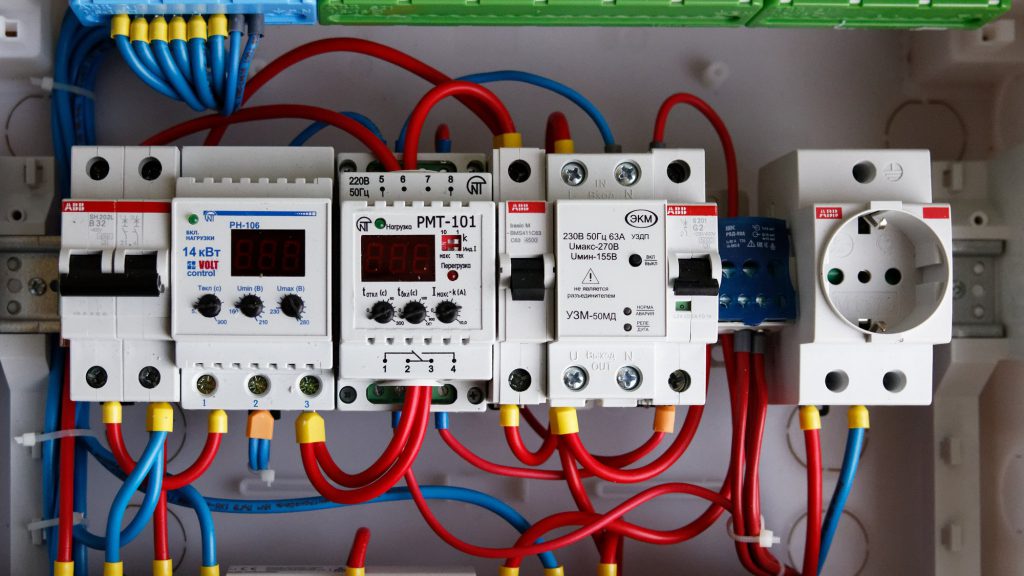
Modular circuit protection devices

Illustrative photo: modular circuit protection devices. Photo by Retired electrician via Wikimedia Commons, CC0.

3. Know exactly what is on the essential board

Over years of renovation, circuits migrate. The essential board should feed life safety systems, lifts, domestic water pumps, cold rooms, IT and security — and not, for example, the spa’s steam generator someone moved onto it in 2016. Walk the schedule against reality once a year.


4. Remember that water is electric

Most Bali properties draw water from wells and booster pumps. If the pumps are not on standby power, the taps run dry within hours even though the lights are on. The same applies to sewage lift stations.


5. Plan the restart

When mains returns, chillers, large motors and every air-conditioning unit trying to start at once can trip the incoming supply. A staged restart sequence — written down and practised — protects both the equipment and the rest of the evening.


Fuel is the quiet risk

Know how many hours of autonomy the day tank and bulk tank actually give at the essential load, who supplies fuel at short notice, and when the stored diesel was last checked for water and sediment. An outage that runs into the night is a fuel problem, not a generator problem.

Not Sure What Your Generator Carries?

We can walk the essential board, test the changeover and give you a plain-language report.

REQUEST A QUOTE

Bali is warm and humid all year, and humid air carries moisture into every room that is not actively dried. When guests complain of a musty smell, or housekeeping keeps finding mould behind the wardrobe, the cause is usually mechanical rather than a cleaning failure.


Cooling is not the same as dehumidifying

An air conditioner removes moisture only while its coil is running cold and long enough for water to condense and drain away. Several common situations stop that happening:


  • Oversized units. A unit that is too big cools the room quickly, switches off, and leaves the moisture behind. The room feels cold and clammy at the same time.
  • Untreated fresh air. Outdoor air brought straight into rooms or corridors without being dried first adds moisture faster than room units can remove it.
  • Negative pressure. If a room’s exhaust removes more air than is supplied, humid outdoor air is drawn in through gaps around doors, windows and services — and condenses inside walls.
  • Units switched off in empty rooms. A closed, unconditioned room in Bali is an incubator. Rooms out of sale still need some dehumidification.
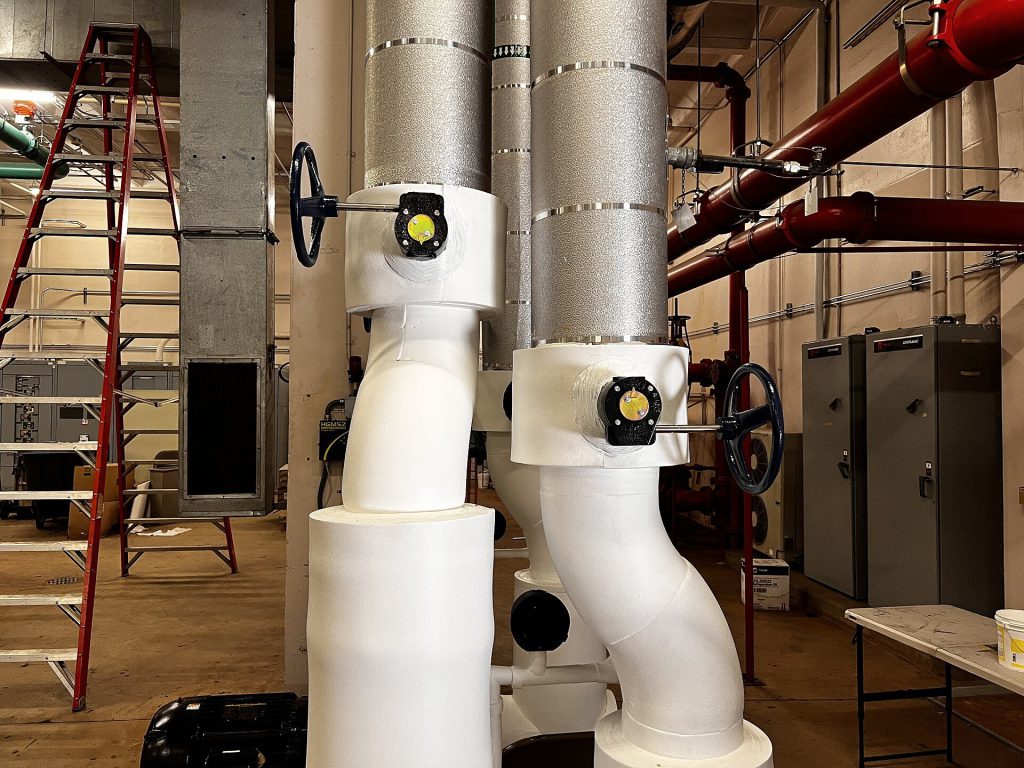
Insulated chilled water pipework

Illustrative photo: insulated chilled water pipework. Photo by IanVG via Wikimedia Commons, CC0.

Where condensation hides

Chilled water pipes and refrigerant lines run far below the dew point of Bali’s air. Wherever their insulation is thin, damaged, or its vapour barrier broken, the pipe “sweats” — and the water drips into ceilings and wall cavities where nobody sees it until a stain appears. The same goes for blocked condensate drains and drain pans that have not been cleaned.


A short checklist for engineering teams

  • Keep room setpoints moderate — around 24–26°C — rather than very low; very cold surfaces in a humid building attract condensation.
  • Clean filters, coils, drain pans and condensate traps on a fixed schedule.
  • Inspect pipe insulation in ceiling voids during every renovation and repair every break in the vapour barrier.
  • Check that each room’s supply and exhaust are balanced so the room is slightly positive, not negative.
  • On coastal sites, rinse outdoor coils and specify corrosion-protected coils, so the units keep running at the capacity they were designed for.


When a property has a persistent mould problem, the lasting fix is usually a design one: correctly sized units and fresh air that is dried before it enters the building.

Rooms That Never Feel Dry?

We can measure humidity, pressures and airflow room by room and tell you where the moisture comes from.

REQUEST A QUOTE

Legionella bacteria live naturally in water. They become a risk when they multiply in a building’s water system and are breathed in as fine droplets — from a shower, a spa pool or a cooling tower. Hotels are a known setting for outbreaks because their systems are large, their occupancy varies, and some outlets go unused for days.


The bacteria grow best at roughly 25–45°C. In a temperate country, cold water usually stays below that range. In Bali, cold water stored in rooftop tanks and run through ceiling voids often does not. That makes the hot water side, and keeping water moving, even more important.


Five checks

1. Hot water storage at 60°C or above

International guidance converges on storing hot water at 60°C or higher, where Legionella is killed within minutes, and keeping circulating hot water at 50°C or more throughout the system. Thermostatic mixing valves close to the outlets protect guests from scalding without lowering the temperature of the whole system.


2. No dead legs

Renovations leave behind pipe branches that once served a removed basin or shower. Water sits in them, warms up and feeds the rest of the system. Every renovation should end with dead legs cut back to the main.

In the tropics, “cold” water is often warm enough to grow bacteria. Flow and hot-water temperature have to do the work.

BCM Project Team

3. Flush outlets that are not being used

Rooms out of sale, rarely used staff showers and guest rooms after a quiet period should have their taps and showers run regularly — weekly is common practice — and before a guest checks in after a long vacancy.


4. Keep tanks cool and covered

Rooftop cold water tanks should be covered, insulated or shaded, inspected and cleaned on a schedule. Sediment and biofilm at the bottom of a sun-warmed tank give bacteria everything they need.


5. Treat and inspect cooling towers

Cooling towers need continuous water treatment, regular cleaning and a maintenance record that someone actually reads. They can spread contaminated droplets well beyond the plant room.


Write it down

The properties that manage this well keep a simple water management plan: a schematic of the system, the temperatures to be checked and where, the flushing schedule, and who is responsible. It is a small document that protects guests and the hotel’s reputation.

Renovating Bathrooms Or Plant?

We design hot and cold water systems that hold temperature, remove dead legs and are easy to maintain.

REQUEST A QUOTE

Polypropylene (PPR) pipe has become the default for hot and cold water in Indonesian hotels and villas. It does not corrode, it insulates better than metal, and its joints are made by socket fusion: the pipe and fitting are heated and pushed together so the plastic becomes one piece.


Done correctly, a fused joint is as strong as the pipe. Done badly, it can look perfect from outside and leak — or block — years later, behind a finished wall. That is why in 2022 five of our technicians — Anggo Arie Saputra, Yudis Setiawan, I Nyoman Suparta, I Made Wira Ardika and I Wayan Picadana — completed Rucika’s socket fusion training and certification.


The steps that matter

  • Cut square and clean. Use a proper pipe cutter, not a saw. Remove burrs and keep the ends clean and dry; dust and moisture weaken the fusion.
  • Mark the insertion depth. Too shallow and the joint is weak; too deep and the softened plastic forms a ring inside the pipe that restricts flow.
  • Heat at the right temperature. PPR welding tools typically run at around 260°C. Check the tool is up to temperature before the first joint, not after.
  • Follow the heating time table. Heating, joining and cooling times increase with pipe diameter. Use the manufacturer’s table rather than guessing.
  • Push straight — never twist. Align the pipe and fitting and join them in one movement. Twisting smears the molten surfaces.
  • Let it cool undisturbed. A joint moved during cooling may never reach full strength.

A PPR joint takes seconds to make and decades to fail. The training is for the decades.

BCM Project Team

Before the wall is closed

Every section is pressure tested before it is concealed — at a test pressure above the working pressure and held for the specified time, following the manufacturer’s and project requirements. Hot water lines are also given room to expand: PPR grows noticeably in length as it heats, so long runs need expansion loops or fibre-reinforced pipe.


Certificates are a habit

The Rucika certificates sit alongside others our team holds: a Class I welding certificate, mechanical and electrical power engineer skills certificates, and K3 construction safety officer and basic safety training. Each one is a person who learned to do one thing properly — which, in the end, is what an MEP contractor sells.

Re-Piping An Operating Hotel?

We plan PPR replacement floor by floor so the hotel keeps running.

REQUEST A QUOTE