
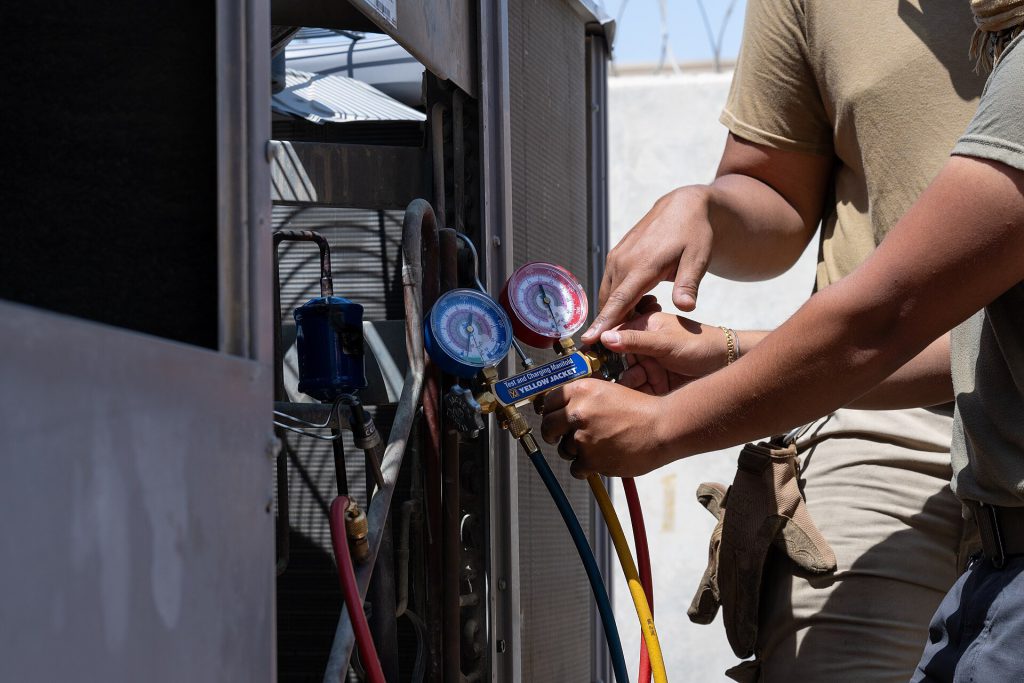
Most of the refrigerants in today’s air conditioning are HFCs — hydrofluorocarbons. They do not damage the ozone layer, but many are powerful greenhouse gases. The Kigali Amendment to the Montreal Protocol commits countries to phase down their use.
Indonesia ratified the amendment through Presidential Regulation No. 129 of 2022, and it took effect for Indonesia in March 2023. The national schedule, based on average consumption in 2020–2022, freezes HFC consumption in 2024 and then reduces it step by step:
- 2029 — at least 10% below baseline
- 2035 — 30% below
- 2040 — 50% below
- 2045 — 80% below
Indonesia does not produce HFCs; every kilogram is imported. As import allowances tighten, the price and availability of high-GWP refrigerants are likely to follow.
Why this matters for an owner today
A chiller or VRV system bought in 2026 should still be running in 2040. Over that life it will need top-ups after leaks and repairs. Equipment that relies on a refrigerant being squeezed out of the market can become expensive to service long before it is worn out.
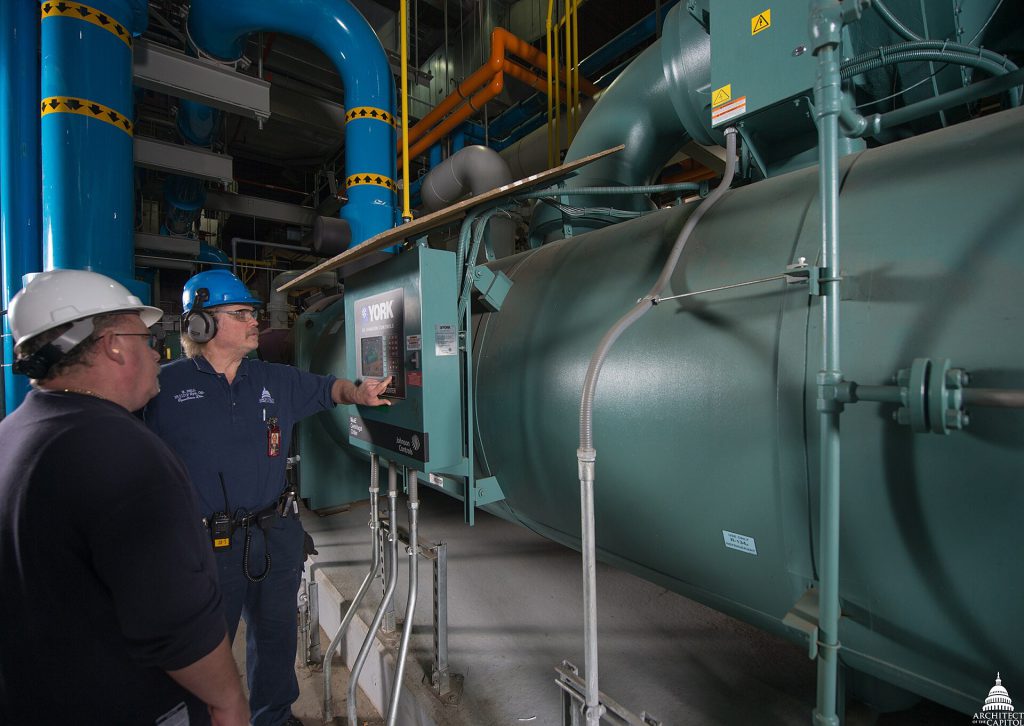
Illustrative photo: a central chilled water plant. Photo by the Architect of the Capitol via Wikimedia Commons, public domain.
Practical steps
- Ask about refrigerant at tender stage. Compare not only efficiency and price but the refrigerant’s global warming potential. R32, for example, has roughly a third of the GWP of R410A, which it is replacing in many split and VRV ranges.
- Treat leak-tightness as a specification item. Brazing under nitrogen, a proper pressure test and deep evacuation before charging are what keep refrigerant in the system for decades.
- Record the charge. Log how much refrigerant each system holds and every top-up. A rising log is the earliest sign of a leak.
- Recover, never vent. Refrigerant removed during service should be recovered and handled properly.
- Plan replacements. If your plant is approaching the end of its life, a planned replacement on a lower-GWP refrigerant is cheaper than an emergency one.
BCM is a member of ASISI, the national association for refrigeration and air conditioning technicians, and our crews work to these practices on every system we install.